



If you want the short version: send on a Tuesday or Wednesday, between 10 a.m. and 11 a.m. in your reader’s time zone. That window hits more open inboxes than any other across most of the send data I’ve watched, and it’s the one I default to when I don’t have a reason to pick something else.
From there, everything gets messier, and more interesting.
The honest truth about send-time advice is that every major benchmark study names a slightly different “best” day and hour, and they’re all correct for the audience they measured. GetResponse’s email marketing benchmarks report, built on more than 4 billion messages, puts Tuesday on top for opens and clicks. MailerLite’s 2026 analysis of over 2 million campaigns lands on Friday for both open rate and click rate. Twilio SendGrid, citing HubSpot’s data, points back to Tuesday, and separately to an 11 a.m. EST send time, for higher open rates.
Three credible sources, three different answers. That’s not a flaw in the data; it’s the whole point. The “best time” is a function of who you’re emailing, and no aggregate study can answer that for you. What a good study can do is give you a starting line. Then you test.
Why the studies disagree (and why that’s useful)
Each benchmark reflects a different user base. GetResponse skews toward small businesses and creators running newsletters. MailerLite’s sample is heavy on ecommerce and content creators. SendGrid moves a lot of transactional and high-volume marketing mail. When you average billions of sends across industries, countries, and list types, the “winner” is whichever audience happened to dominate that platform’s sample that year.
So when GetResponse says Tuesday and MailerLite says Friday, neither is wrong; they’re describing different populations. The useful move is to stop hunting for the single universal answer and start treating the studies as a range of reasonable starting points. Mine is Tuesday-Wednesday, late morning. Yours might end up elsewhere, and that’s fine.
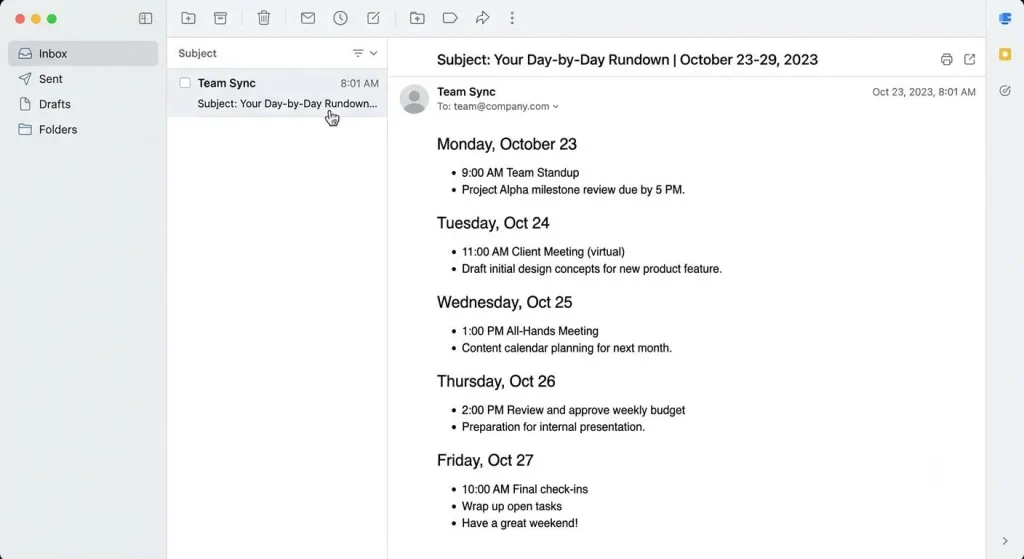
The day-by-day rundown
Here’s how I think about each weekday, based on what I see across the emails our users send through WriteMail.ai and what the benchmark data tends to support.
Monday:
Inboxes are full from the weekend. People are in cleanup mode, deleting ruthlessly. Open rates can look decent because everyone checks email, but click-through is usually flat. I avoid Monday for anything important. If you must, send late morning after the purge settles.
Tuesday:
The strongest all-around day in most benchmarks, including GetResponse’s. The inbox has cleared, people are in execution mode, and attention is higher than it’ll be all week. This is my default for newsletters, outreach, and anything I actually need a response on.
Wednesday:
Nearly as strong as Tuesday and slightly less crowded. If Tuesday is booked or you want to avoid the mid-morning send rush, Wednesday late morning is a great second choice. I often split a test between Tuesday and Wednesday to see which my specific audience prefers.
Thursday:
The most popular day to send in MailerLite’s data, which is exactly why I’m cautious about it. When everyone sends on Thursday, your email competes with more noise. Engagement can hold up, but it’s a busier inbox. Good for follow-ups, less ideal for a flagship send.
Friday:
MailerLite’s data puts Friday on top for both opens and clicks, and I’ve seen this too, but only for certain audiences. B2C and lifestyle lists often perform well on Friday afternoon, when people are mentally winding down and browsing. B2B? It falls off a cliff after lunch. Know your audience before you bet on Friday.
Saturday:
Low volume, low competition, low urgency. Weekend sends can surprise you with ecommerce and consumer audiences who check phones on the couch. For anything work-related, skip it.
Sunday:
Similar story to Saturday but worse for B2B. I’ll occasionally test a Sunday evening send for consumer newsletters; people planning their week sometimes open more than you’d expect. Mostly, though, leave it alone.
The hour that matters more than the day
In my experience, the hour matters more than the day. You can pick the perfect Tuesday and still lose if you send at 4 p.m. when your reader is in a meeting.
The window I keep coming back to is 10 a.m. to 11 a.m. in the recipient’s local time. Here’s why it works: by 10 a.m., the morning inbox purge is done, but the post-lunch slump hasn’t hit. People are at their desks, working through their list, and your email lands while they’re still in active-triage mode rather than end-of-day survival mode.
SendGrid’s data lines up with this; they found an 11 a.m. EST send correlated with higher open rates. A secondary window I watch is 1 p.m. to 2 p.m., right after lunch. It’s quieter and can catch the people who cleared their morning and are easing back in. I’d avoid first thing in the morning (7-8 a.m.), when your email joins the overnight pile and gets swept up in the purge, and late afternoon (after 4 p.m.), when attention is gone.
B2B vs B2C: the split that changes everything
The single biggest factor in your best send time isn’t the day; it’s whether you’re emailing someone at work or at home.
For B2B, weekday mornings win, full stop. Tuesday through Thursday, 9 a.m. to 11 a.m., is the sweet spot. People read work email when they’re working. Friday afternoon and weekends are dead. I’ve watched otherwise strong campaigns get a fraction of their expected response because they went out Friday at 3 p.m.
For B2C, the rules loosen. Evenings and weekends come into play. Friday afternoon and Saturday morning can outperform midweek for retail, lifestyle, and entertainment. People shop and browse when they’re off the clock. If your list is consumers, test a Friday 5 p.m. or Saturday 10 a.m. send before you assume Tuesday is best.
Time zones: the silent killer
If your list spans time zones and you blast everyone at once, you’re sending at the “right” time for one slice and the wrong time for everyone else. A 10 a.m. ET send lands at 7 a.m. in Los Angeles and 3 p.m. in London – three different moments in the recipient’s day.
My rule of thumb: if more than 20% of your list sits in a different time zone, segment by region and send in local time, or at least split into two sends. Most modern email tools handle time-zone sending natively. If yours doesn’t, stagger by list segment. Sending to “everyone at once” is the most common reason a perfectly timed campaign underperforms.
The decision rule I actually use
Here’s the practical framework I run, and the one I’d suggest you steal:
- Start with Tuesday or Wednesday, 10-11 a.m. in your reader’s local time. It’s the safest default across the benchmarks and my own data.
- Pick a second window to test against – Wednesday 1 p.m., or Friday 10 a.m. for B2C. Same content, different slot.
- Run both for a month with whatever volume you have. Don’t trust a single send; one Tuesday could’ve been a holiday.
- Go with the winner, but retest quarterly. Audiences drift. What worked in January can shift by July.
That’s it. You don’t need a perfect answer – you need a repeatable test that finds your answer and updates it when your audience changes.
What I’d skip
A few things that sound smart but don’t pay off:
- Sending at odd hours to “stand out.” A 3 a.m. send doesn’t make you clever; it buries your email under everything that arrives after it. Inboxes rank by recency, and yours just got old.
- Chasing one platform’s “best” number without context. A 49% open rate sounds great until you realize it’s measured on a B2C lifestyle list and you run B2B SaaS.
- Ignoring Apple Mail Privacy Protection. Since Apple started pre-loading emails, open rates are inflated and noisy. Treat opens as a directional signal, not a precise count – and weight click-through more heavily when you judge timing.
Conclusion
The best time to send an email is the time your specific audience is most likely to open and act – and the only honest way to find that is to test. Use Tuesday or Wednesday at 10-11 a.m. as your starting line, borrow the benchmarks as a sanity check, and let your own data make the final call. The studies disagree because their audiences disagree; your job is to stop arguing with the aggregate and start listening to your list.