

Most advice about persuasive email is really advice about pressure. Fake deadlines. Manufactured scarcity. A subject line that says “Re:” on a thread that never existed. Those tricks work often enough that people keep using them, and they cost you the only thing email actually runs on, which is whether this person opens your next message.
The six techniques below go the other direction. Every one of them makes it easier for someone to say yes, rather than harder for them to say no. That sounds like a small distinction. It’s the whole article.
Put the ask in the first three sentences
You already know what you want before you start typing. Then you spend four paragraphs warming the reader up for it, because asking straight out feels rude, and because some part of you assumes the answer is no anyway.
That assumption is probably wrong. Francis Flynn and Vanessa Lake ran a set of studies on how people estimate compliance with direct requests, published in the Journal of Personality and Social Psychology in 2008. Across experimental and real-world field settings, people underestimated by as much as 50% how likely others were to agree to a direct request for help. The gap wasn’t in how often people said yes. It was in how badly the person asking had predicted it. Those studies looked at in-person requests, not email, but the instinct they measured is the same one that makes you rewrite an ask four times before sending it.
Here’s what burying it looks like:
Now the same request, front-loaded:
Marcus can answer the second one from his phone in a queue at the airport. The first one requires him to read 90 words to find out what he’s being asked, which is work you handed to him instead of doing yourself.
Notice the second email still says thanks and still sounds like a person. Directness and warmth aren’t trading against each other here. You only moved the ask above the padding.
Trade every vague noun for a number, a name, or a date
Vagueness reads as low commitment. If you haven’t bothered to work out the specifics, the reader assumes there aren’t any, and that whatever you’re proposing will land on their desk half-formed.
Concrete detail does measurable work in adjacent territory. Cynthia Cryder, George Loewenstein and Richard Scheines at Carnegie Mellon ran three experiments on charitable giving and found that giving people tangible details about how a contribution would be used significantly increased willingness to act, compared with describing the same need in general terms. That’s donations, not inboxes. But the mechanism travels: a request someone can picture is a request they can evaluate.
Watch what happens to a freelance pitch when the nouns get replaced.
Nothing there is checkable. Try it this way:
The second version can be refused in four seconds. That’s a feature. Every specific you add gives the reader a faster path to a decision, and fast decisions favor you more often than slow ones.
Specificity has a ceiling, though. Dana’s pitch works because each detail earns its spot: one article, one observation, one price, one small test. Stack on six paragraphs of process and portfolio history and you’ve rebuilt the wall of text you were trying to avoid. My bar for keeping a detail is whether it helps the reader decide. If it only proves you did your homework, cut it.
Do the work they would have to do to say yes
Yes is never free. There’s always a hidden bill attached: a paragraph they have to write, a file they have to dig up, a calendar they have to check, three people they have to loop in. Most emails that die in an inbox weren’t rejected. They were postponed, and then postponing became the answer.
So pay the bill yourself before you send.
Asking for an introduction is the clearest case. Almost everyone sends the version that says “would you mind introducing me to Sam?” and leaves the writing to the person doing them a favor. Send this instead:
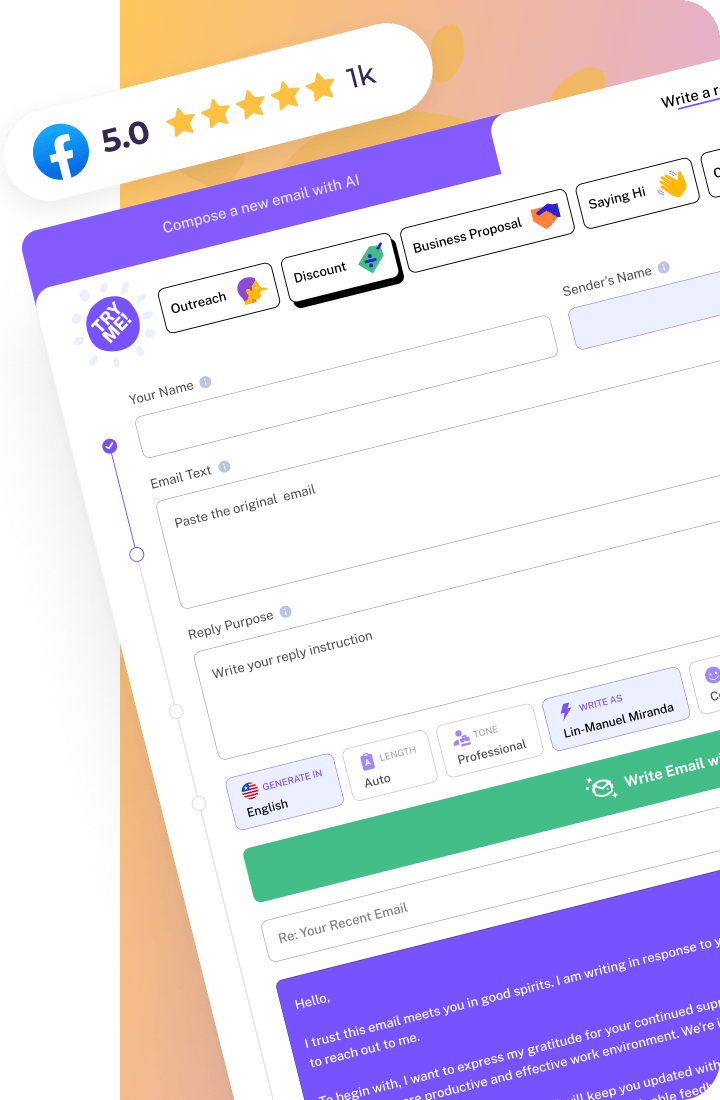
Elena’s cost just dropped from “compose a thoughtful introduction” to “hit forward.” The same principle applies everywhere else. Propose two specific times instead of asking about availability. Attach the document instead of offering to send it. Write the first draft of the thing you want approved and ask what to change. If you’d rather not start from a blank page each time, WriteMail.ai will hand you a draft to react to, though the deciding move is still yours: work out what the reader would have to do, and do as much of it as you can before you hit send.
Delete the words that apologize for the email existing
My rule before sending anything with an ask in it: reread the draft and delete every word doing apology work. Just. Sorry to bother you. I was wondering if. If it’s not too much trouble. Hopefully this isn’t a stupid question. Then reread what’s left and check whether it still makes sense. It almost always does, and it almost always reads better.
I’ve never seen this proven in a study I’d be comfortable citing, so take it as one writer’s opinion rather than a finding. But I’ve watched it play out enough times to trust it. “I was just wondering if you might possibly have a moment” tells the reader you don’t think your request deserves their attention, and readers tend to take you at your word about that.
The nuance matters, because softening isn’t the same as apologizing. Warmth is fine. Warmth is good. If you’re writing to someone senior you’ve never met, or apologizing for something you genuinely got wrong, or asking a real favor of a busy stranger, courtesy belongs in the email. What doesn’t belong is the reflex to apologize for the act of writing at all.
Compare “Sorry to bother you again about this” with “Following up on the invoice from the 3rd.” One of those is an apology for existing. The other is a fact and a date.
Give them a clean way to say no
This is the one that sounds backwards, and it’s the one I’d argue hardest for.
Add a line that makes refusal easy and costless. Something like: “If this isn’t a fit, a one-line no is completely fine and I won’t chase it.” Or: “Totally understand if your plate is full right now.”
Every unanswered email I’ve ever sent taught me the same thing. Silence usually isn’t rejection. Silence is somebody who doesn’t want to write the awkward paragraph explaining why they’re declining, so the message sits there decaying instead. You get no answer, no information, and a lingering question about whether to follow up.
Two things happen when you hand someone an exit. The first is that you get answers, including fast ones, which frees you to go ask someone else. The second is subtler and more valuable: a yes from someone who knew they could easily refuse is a real yes. They’re actually in. Compare that to the yes you extract by making refusal socially expensive, which tends to turn into a missed deadline three weeks later.
Your follow-up is where this matters most, because that’s where pressure creeps in. You’ve invested something by then and the silence stings, so the temptation is to narrow the exit. Widen it instead. “Circling back once, then I’ll leave it alone” costs you nothing and tells the reader you aren’t going to become a recurring problem in their inbox.
Pushy email is built on removing the exit. Persuasive email leaves it wide open and makes the yes more appealing anyway.
Name what’s at stake, and know exactly where the line is
People weigh potential losses more heavily than they weigh equivalent potential gains. Daniel Kahneman and Amos Tversky described the pattern as part of prospect theory, originally published in Econometrica in 1979, and it’s the reason “here’s what this costs you” tends to land harder than “here’s what this gets you.”
It’s also the easiest technique here to turn into something ugly, which is why you’re getting it last.
Loss framing is honest when the loss is real and would exist whether or not you sent the email. It becomes manipulation when you invented the loss to create pressure. That’s the whole test, and it isn’t a subtle one.
The printer’s queue exists. Nadia didn’t invent it to make Rob move faster. She’s telling him something true that he’d want to know, and he can go check it himself in about a minute.
When it isn’t. When the same email goes out every Tuesday with a fresh 24 hours bolted on.
Two questions will tell them apart for you. Would this sentence still be true if the reader checked it next week? And could you say it out loud, to their face, without adjusting your tone? Real deadlines survive both. Manufactured ones fail the first, and you can usually hear yourself failing the second.
One caution. Loss framing is potent enough that it wears out fast. Save it for the emails with an actual clock on them, and let the other five carry everything else.
Where to start
Don’t try to install all six at once. Open your sent folder, find one email from the past fortnight that never got a reply, and rewrite it using technique one alone. Move the ask to the top. Cut everything that came before it.
That single change fixes more dead emails than the other five combined, in my experience, because burying the request is the most common thing people do and the easiest thing to stop doing. Once it feels automatic, add specificity. Then start paying the reader’s cost before you send.
None of this needs a tool, and WriteMail.ai only helps with the part that was never really the problem, which is getting words onto the page. The persuasion happens in the decisions you make before the first sentence: what you’re actually asking for, what it costs the other person, and whether you’re willing to let them say no.