

Somewhere in your inbox right now is an email you will never finish. Not because the writer had nothing worth saying, but because whatever they actually needed from you is buried in paragraph six, behind a recap of a meeting you attended and a restatement of context you already have.
That is the mistake most people make with length. They treat it as a formatting choice, a slider between “short and rude” and “long and thorough.” It is not. Length is a consequence of two other decisions: how much your reader already trusts you, and how specific your ask is. Get those right and the correct length mostly decides itself. Get them wrong and no amount of trimming or padding will save the message.
Here is what the data actually says, and where the usual advice steers you wrong.
“Keep it short” is true, and almost useless
The most-quoted number in this territory comes from a 2016 analysis by Boomerang of over 40 million emails. Their finding: “The sweet spot for email length is between 50-125 words, all of which yielded response rates above 50%.”
That is the part everyone quotes at you. The part almost nobody mentions is what happened next in the same dataset. Response rates slid from 50% at 125 words to about 44% at 500 words, then stayed flat all the way out to roughly 2,000 words before falling off properly.
Read that again. Quadrupling the length of your email cost about six percentage points.
Six points is not nothing. But it is nowhere near the penalty implied by an industry that treats every extra sentence as a sin. The curve is close to flat across a range your emails probably never even approach. One caveat worth stating plainly: Boomerang measured replies among its own users who had set reminders for unanswered mail, so this is data about emails that got answered, not about marketing performance.
So the honest version of the rule is this. Brevity is not a virtue. Clarity is a virtue. Brevity is what happens when you delete everything that was never doing a job.
That distinction matters, because the internet is full of advice to write short emails, and people follow it in the worst possible way: by stripping out the context the reader needed in order to act. A two-line email that forces the recipient to reconstruct your situation is not efficient. It is outsourcing your work to them.
The only length rule worth memorizing
Before you send anything, check that every sentence clears one of three bars.
- It gives the reader information they will act on.
- It removes a question they would otherwise have to ask.
- It earns the ask you are about to make.
If a sentence does none of those, cut it. If all of your sentences clear the bar, write as long as you need.
That is the whole discipline. What follows is what it looks like in practice, because the point where “necessary” begins moves a great deal depending on who is reading.
Cold outreach: short, specific, and about them
When you email a stranger you have no trust budget. Every word has to buy its own way in, and the fastest way to burn the opening is to spend sentences on yourself. The reader’s silent question is “why are you in my inbox,” and you have about four lines to answer it.
(67 words.) That email works not because it is short but because it is specific to one person. You can tell the writer actually looked. It names a plausible problem, offers evidence, and asks for something small.
(70 words.) Three words longer than Dana’s, and you would delete it without reaching the end. The second is generic enough that the reader knows, correctly, that it went to four hundred other people. Length was never the problem here. The absence of any reason it had to be them was.
If your cold email still works when you swap in a different company’s name, it is not ready to send.
Follow-ups: add information, or add nothing
The follow-up has a reputation problem because most of them are lazy. “Just bumping this to the top of your inbox” contributes nothing, and readers know that bumping is about the sender’s to-do list rather than theirs.
The fix is not silence. It is a follow-up that adds one new thing:
(43 words.) Shorter than the original, which is usually right. The context already exists, so you only owe the reader the delta. It also makes the easy reply frictionless, and offering someone a clean exit gets more responses than pressure does.
Internal updates: completeness is the kindness
Here is where the “shorter is better” instinct does real damage. Colleagues cannot ignore you the way a prospect can. They have to process whatever you send, plus every clarification thread that follows.
The most expensive emails in any company are the ones that skipped context to stay brief and generated four reply-alls asking what the actual status is. Write the full picture:
(91 words.) Longer than anything above, and correctly so. Every line either removes a future question or enables a decision. Nothing in it is decoration, and nobody on your team has to send a follow-up asking what you actually meant.
Broadcast email operates under a harsher constraint than anything you send to one person, and the research here is old but has never really been beaten. In a 2006 eyetracking study, the Nielsen Norman Group watched 42 people read 117 newsletters. Average time spent on an opened newsletter: 51 seconds. Participants fully read 19% of them. The dominant behavior was scanning, not reading.
The detail worth sitting with: 67% of readers had zero eye fixations in the newsletter introduction. Two thirds of your audience never looked at the opening paragraph at all. Not skimmed it. Never landed on it.
Attention has not improved since. Litmus found that average time spent with an email fell from 13.4 seconds in 2018 to 8.97 seconds in 2022.
So the implication is not “write less.” It is that you should write for someone whose eyes are moving fast:
- One idea per email. Three ideas means three emails, or one clearly sectioned digest.
- The first sentence has to make the subject line’s promise concrete.
- Bold sparingly, for real checkpoints, not emphasis theater.
- Assume every paragraph might be the last one read.
Customer support: the answer goes first
Support replies fail in a way that has nothing to do with total length and everything to do with ordering. The reader arrived with one question. Make them scroll to find out whether it is solved and your email has failed, however polite it was.
Here is the version most people send:
(94 words, and Alex has to reach the second-to-last sentence to learn the problem is fixed.)
Same information, reordered:
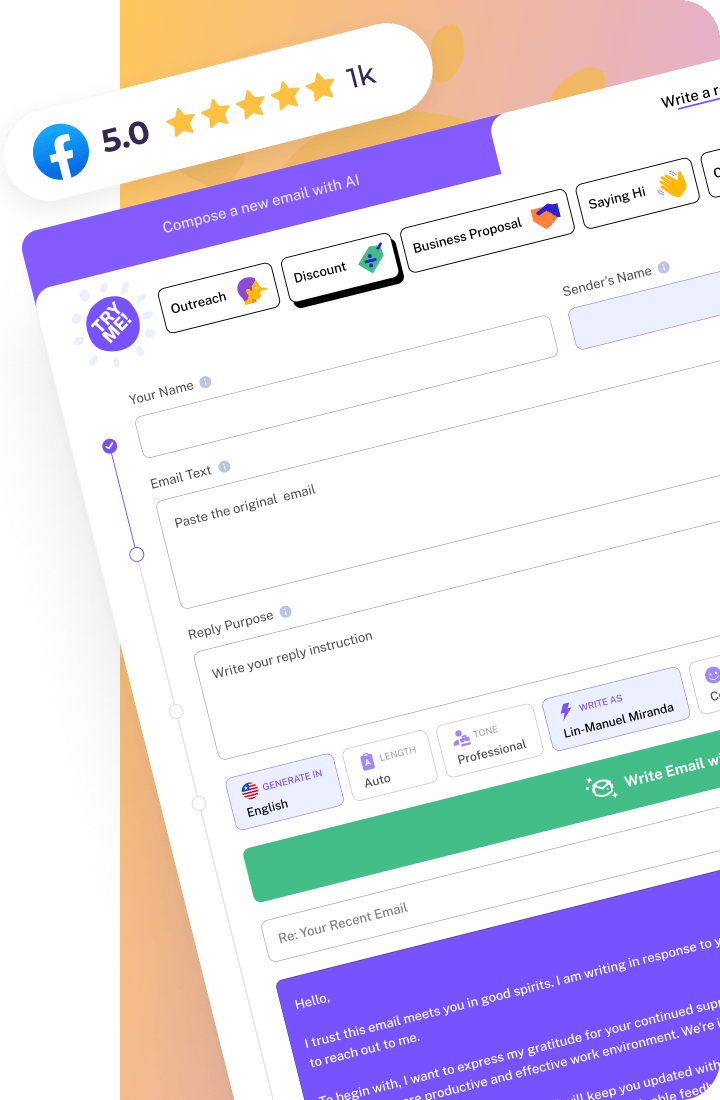
(81 words.) Barely shorter. Enormously better, because the first word answers the question. Everything after it is optional reading, which is exactly what good structure buys you. This is the pattern worth saving as a template. However you draft support replies, in WriteMail AI or straight into the helpdesk, put the verdict first and let the explanation follow.
The bad-news email: brevity backfires
Now the one where the usual advice actively hurts you. When you have to say no, deliver a delay, or own a mistake, the temptation is to be crisp. State the decision, keep it tight, don’t wallow. It feels respectful.
It reads as indifference. What the reader experiences is you protecting yourself from the discomfort of the moment they are having.
Consider what most people send:
(12 words.) Technically efficient. Functionally it torches the relationship, because the reader concludes you knew this would land badly and hoped they wouldn’t make a scene.
(149 words.) More than twelve times the length of the brush-off, and the right call every time. Those extra sentences are not decoration. They are the apology, the accountability, and the evidence that you took the reader seriously. That is work the email is supposed to do, and there is no compressed version of it.
The pattern underneath all of it
Notice that none of these rules told you to hit a word count, even though every example had one.
- Cold and unread: earn every sentence, assume skepticism, keep the ask small.
- Warm and recurring: be complete, because ambiguity compounds across a team.
- Answering a question: verdict first, explanation second, length almost irrelevant.
- Bad news: err long and specific, because vagueness reads as concealment.
“Shorter is better” is a decent first approximation for cold outreach and a genuinely bad model for everything else. The real question, every time, is what your reader needs in order to stop thinking about this. Sometimes that is one sentence and a link. Sometimes it is a 300-word status update with the risk stated plainly.
One habit to steal
Before you send, read only the first two sentences of your draft. Ask whether a busy stranger would know, from those alone, what you want and why it involves them.
In a real inbox those two sentences are often all anyone sees before deciding whether the rest of yours gets read. Write them as though they are the only ones that exist, and make everything after them justify the attention it is asking for.