


You missed the deadline. The client got the wrong numbers. You snapped at a colleague in a meeting you both wish you could forget. Now you need to write an email that says more than “sorry” – one that actually repairs the damage.
In my experience, most apology emails fail. Not because the person isn’t sorry, but because the email reads like damage control instead of accountability. There’s a gap between saying “I apologize” and the other person thinking “OK, I trust them again.” This guide closes that gap.
Get it right, and the relationship can come back stronger than before. Get it wrong, and your apology becomes the reason they stopped trusting you.
Below you’ll find the structure that works, the phrases that backfire, templates you can adapt for different situations, and the follow-up steps that prove you mean it.
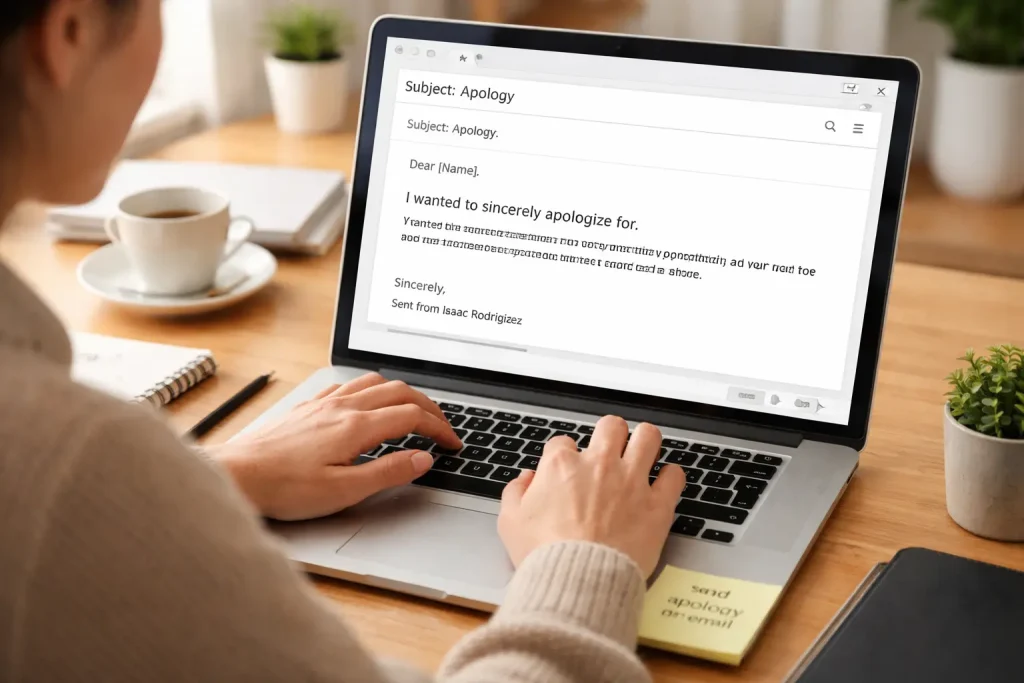
The Anatomy of an Effective Apology Email
Structure matters as much as sincerity. A good apology email covers four things in order: what happened, why it matters, what you’ll do about it, and how you’ll prevent it next time.
Let’s break down the key components you should include in your next apology email.
Clear Acknowledgment Without Qualifications
The foundation of any effective apology is explicitly acknowledging what went wrong. You need to name the specific mistake or issue without hedging or minimizing it. This means avoiding phrases like “if you were offended” or “mistakes were made” which subtly deflect responsibility.
Instead, try statements like:
- “I missed our deadline for delivering the quarterly report.”
- “I provided you with incorrect information about the project timeline.”
- “I spoke over you during yesterday’s client presentation.”
When you directly acknowledge what happened, you signal to the recipient that you fully understand the issue and aren’t attempting to sidestep accountability. This direct approach builds the foundation for rebuilding trust.
Expression of Genuine Remorse and Empathy
After acknowledging the mistake, express real remorse. Saying “I’m sorry” is the minimum. What matters more is showing you understand the specific impact your mistake had on the other person.
Effective expressions of remorse include:
- “I sincerely apologize for missing this deadline and causing you additional stress.”
- “I’m truly sorry for the confusion this has created for your team.”
- “I regret not giving this matter the attention it deserved and understand how frustrating this has been for you.”
The difference between a weak apology and a strong one is impact awareness. Don’t just name what you did wrong – show that you understand how it affected the other person’s work, time, or stress level.
Complete Apology Email Example Apology for Missing the Project Deadline
Concrete Explanation of Prevention Measures
An apology without a plan for change is just words. For your apology to truly rebuild trust, you must outline specific steps you’ll take to prevent the same issue from recurring in the future.
Be as specific as you can here. “I’ll do better next time” means nothing. Compare that to these:
- “I’ve set up three calendar reminders for future deadlines and created a progress tracking document that I’ll update daily.”
- “I’ve enrolled in a project management course to improve my timeline estimation skills.”
- “I’ve implemented a new verification process where all client-facing information is double-checked by a team member before being sent out.”
Specific prevention steps show you’ve thought about why this happened, not just how to patch it. That’s what separates an apology that rebuilds trust from one that just buys time.
Appropriate Offer of Remedy or Compensation
The final component of an effective apology email is offering an appropriate remedy. This step shows your commitment to making things right, not just feeling bad about what happened.
When designing a remedy, consider these factors:
- Proportionality: Your remedy should match the severity of the mistake
- Relevance: The remedy should address the specific harm caused
- Feasibility: Only offer what you can realistically deliver
For example, if you missed a deadline that impacted a client presentation, appropriate remedies might include:
- Working extended hours to deliver the materials as quickly as possible
- Offering a discount on the current project
- Providing additional services at no cost to make up for the inconvenience
The strongest remedies go beyond fixing the immediate problem. They show you’re thinking about the relationship long-term. A discount handles today’s frustration. A new process that prevents the mistake from recurring handles tomorrow’s trust.
Timing and Tone: Critical Elements for Rebuilding Trust
Timing matters as much as the words you choose. The moment you realize the mistake, the clock starts ticking. Wait too long and the recipient reads your silence as indifference – or worse, as a deliberate choice not to address it.
The Science of Timely Apologies
In my experience, the longer you wait, the less sincere your apology sounds. I’ve noticed that a same-day email tends to read as genuine reflection. An email a week later can read as damage control – even if the words are identical.
Practical timing guidelines:
- Minor issues: Apologize within 24 hours
- Moderate problems: Respond within 4-12 hours
- Serious mistakes: Address within 1-4 hours whenever possible
- Crisis situations: Respond immediately, even if just to acknowledge the issue while you prepare a more thorough response
Remember, if you need time to gather facts or develop a solution, it’s better to send a quick acknowledgment first rather than wait until you have everything figured out. You might say, “I’m aware of what happened and am investigating the details now. You’ll have my full response by end of day.”
Striking the Right Tone
Once you’ve committed to timely action, your next challenge is getting the tone right. The same apology can land completely differently depending on how you frame it, especially in email where your recipient can’t see your facial expressions or hear your voice.
The appropriate tone depends on several factors:
- Relationship context: A close colleague requires a different approach than a new client
- Cultural considerations: Some cultures value directness while others prefer more formal expressions of regret
- Severity of the mistake: Minor inconveniences need a lighter touch than serious breaches of trust
- Industry norms: What’s appropriate in a creative agency differs from what works in legal or financial services
Adjust your language, sentence length, and formality based on these factors. When in doubt, go slightly more formal than your usual tone.
Example: Same Apology With Different Tones for Different Situations Apology for the Delayed Report (Formal Client Version)
Sorry about the late report – my bad (Colleague Version)
Notice how both emails convey the same core message but adjust formality, sentence structure, and word choice to match the relationship context. The client version is more formal and comprehensive, while the colleague version is conversational but still takes full responsibility.
Using AI to Calibrate Your Tone
When you’re feeling emotional about a mistake (embarrassed, defensive, anxious), it can be particularly difficult to strike the right tone in your apology. This is where AI writing tools can be invaluable in helping you calibrate your language for sensitive communications.
These tools can help you identify potentially problematic phrases, suggest more empathetic alternatives, and ensure your apology hits the right notes of sincerity without sounding either overly formal or inappropriately casual. Just remember that the final email should still sound like you—the AI is there to enhance your communication, not replace your authentic voice.
The Personal Touch Matters
Personalization is what separates an apology that lands from one that gets ignored. People can spot a form letter immediately, and nothing undermines an apology faster than the impression it was copy-pasted.
To ensure your apology feels personal and genuine:
- Address the specific situation in detail rather than using vague references
- Mention the impact of your actions on this particular person or team
- Reference your relationship or previous interactions when appropriate
- Tailor your solution to their specific needs or preferences
- Use their name naturally throughout the email (but don’t overdo it)
Even when you’re apologizing to multiple stakeholders, take the time to customize each message. The few extra minutes this requires will significantly increase your chances of successfully rebuilding trust.
Timing and tone work together. The right apology delivered a week late still feels like an afterthought. A fast response in the wrong tone makes it worse. Get both right and you give the relationship a real chance to recover.
Common Mistakes That Undermine Apology Emails
Small mistakes in apology emails don’t just weaken your message – they can make the situation worse than not apologizing at all. These are the patterns that backfire most often.
The Danger of “Non-Apologies”
One of the most prevalent mistakes I see is what psychologists call the “non-apology apology” (https://en.wikipedia.org/wiki/Non-apology_apology). This occurs when you appear to take responsibility but actually deflect blame through careful language choices. When you write phrases like “I’m sorry if you were offended” or “mistakes were made,” you’re subtly shifting responsibility away from yourself.
I’ve seen cases where a bad apology did more damage than no apology at all. When someone reads “I’m sorry you feel that way,” they don’t hear remorse – they hear deflection. And deflection from someone who’s supposed to be taking responsibility feels manipulative.
Common non-apology phrases to avoid:
- “I’m sorry you feel that way” (invalidates their feelings)
- “I apologize for any inconvenience” (minimizes the impact)
- “Mistakes were made” (uses passive voice to avoid personal responsibility)
- “I regret if anyone was offended” (conditional apology that places blame on the recipient’s sensitivity)
Instead, be direct and own your actions: “I apologize for missing our deadline” rather than “I’m sorry about how things turned out with the timeline.”
Over-Explaining or Making Excuses
When you feel defensive, it’s tempting to launch into a detailed explanation of why you made the mistake. While context is important, there’s a fine line between explanation and excuse-making. Here’s a good rule of thumb: if your explanation is longer than your actual apology, the reader stops hearing remorse and starts hearing excuses.
I recommend following what I call the “30/70 rule” — spend no more than 30% of your email explaining what happened, and at least 70% focusing on understanding the impact, expressing genuine remorse, and outlining concrete steps to make things right.
Signs you’re over-explaining:
- Your explanation is longer than your actual apology
- You find yourself mentioning factors outside your control
- You’re repeating explanatory points multiple times
- You’re including irrelevant details to justify your actions
Example of a Problematic Apology Email Regarding Yesterday’s Presentation Issues
What’s wrong with this apology:
- “These things happen sometimes” – Normalizes the failure instead of acknowledging its seriousness
- “I’m sorry if anyone was frustrated” – Classic non-apology using conditional language
- “As you know, our IT department…” – Shifts blame to another department
- “I did ask for the presentation room to be checked” – Defensive justification
- “We’ll try to do better” – Vague commitment without specific action steps
- No acknowledgment of the actual impact on the client relationship
Avoiding Unrealistic Remedies
When you’re feeling guilty, it’s tempting to overcompensate with promises you can’t realistically keep. A broken promise after an apology almost always does more damage than the original mistake. The person gave you a second chance, and you burned it – that’s harder to come back from than the first screwup.
A practical approach: only commit to what you’re 100% certain you can deliver, then add one small gesture that goes slightly beyond what was expected. Under-promise and over-deliver – especially after you’ve just let someone down.
Guidelines for appropriate remedies:
- Before making a promise, ask yourself: “Am I 100% confident I can deliver this?”
- Be specific about timeframes and deliverables
- Consider your commitment from the recipient’s perspective—is it proportionate to the impact of your mistake?
- If appropriate, offer options rather than prescribing a single solution
- Don’t promise systemic changes you don’t have authority to implement
Every word in an apology email carries more weight than usual. Avoid these mistakes and you’ll write apologies that actually rebuild trust instead of eroding it further.
Industry-Specific Apology Strategies
How you apologize to a customer is different from how you apologize to a colleague or your boss. The stakes, the tone, and the follow-through all shift depending on the relationship. Here’s how to adjust your approach for each.
Customer Service Apologies: Finding the Right Balance
When you’re apologizing to customers, you’re walking a fine line between company policy and genuine human connection. Research published in Harvard Business Review (https://hbr.org/2018/01/how-customer-service-can-turn-angry-customers-into-loyal-ones) found that how companies respond to complaints – not the complaint itself – is the primary driver of whether customers stay or leave. A fast, honest response can actually increase loyalty – and in my experience, a slow, defensive one almost guarantees they tell people about it.
Here’s how you can strike the right balance:
- Acknowledge company responsibility – Even if you weren’t personally responsible, use “we” language to show organizational accountability
- Offer something concrete – a refund, credit, or expedited resolution. Vague promises to “look into it” don’t rebuild confidence.
- Personalize the response – Mention specific details about their situation rather than sending a generic template
- Own the fix personally – “I’ll handle this and update you by Friday” beats “our team will review this.“
In customer service, your apology isn’t just personal – it’s your brand talking. One good recovery can create a more loyal customer than if nothing had gone wrong.
Team and Colleague Apologies: Maintaining Professional Respect
When apologizing to colleagues, the dynamics shift significantly. You’re dealing with ongoing relationships where trust is essential for daily collaboration. Most workplace tension doesn’t start with the mistake itself – it starts with how (or whether) someone takes responsibility afterward.
For effective colleague apologies, you should:
- Be direct and specific – Vague apologies leave room for lingering resentment
- Acknowledge impact on their work – Show you understand how your mistake affected their responsibilities
- Suggest a concrete plan – Offer clear steps for how you’ll work differently going forward
- Keep it professional – Even with close work friends, maintain appropriate boundaries in written apologies
Colleague apologies work best when they’re short and solution-focused. Your coworker doesn’t need to hear how bad you feel – they need to know the workflow is fixed.
Example: Client Apology for Missed Deadline
Apology for Delayed Project Delivery + Action Plan
When you’re in a leadership position, your apologies carry extra weight. From what I’ve observed, leaders who apologize openly tend to build more trust, not less. Teams take cues from how their leader handles mistakes – dodge accountability and the whole team learns to do the same.
As a leader, your apology emails should:
- Take clear ownership – Phrases like “As your manager, I made a mistake when I…” demonstrate secure leadership
- Connect to organizational values – Frame the apology in terms of shared principles
- Outline structural changes – Show how systems will be improved, not just individual behavior
- Model the behavior you expect – Your apology sets the standard for how team members should handle their own mistakes
When a leader owns a mistake publicly, it gives everyone else permission to do the same. That’s how accountability becomes a team norm instead of a vulnerability.
Using Context-Specific Templates as Starting Points
Templates give you a starting structure so you’re not staring at a blank screen when you’re already stressed. Purpose-built email tools offer templates for different professional scenarios – customer complaints, colleague mistakes, leadership accountability.
The point isn’t to send a template verbatim. It’s to get the structure right (acknowledgment → impact → fix → commitment) and then make it specific to your situation.
When using any template, I recommend you:
- Customize at least 60% of the content to reflect the specific situation
- Adjust the tone to match your relationship with the recipient
- Include specific details about the incident in question
- Review for authenticity – does it sound like something you would actually say?
The best apology emails use a template as scaffolding, not a script. Cover the structure, then rewrite at least half of it in your own words for your specific situation.
Following Up After the Apology
Sending the apology is step one. What you do after it determines whether the relationship actually heals. Your apology is a promise. Your follow-up is proof you meant it.
The Critical Post-Apology Timeline
Timing matters tremendously when it comes to following up after an apology. Wait too long, and your sincerity comes into question; follow up too quickly, and you might appear insincere or pushy.
Recommended Follow-Up Timeframes:
- For minor issues (missed meeting, small delay): 3-5 business days
- For moderate issues (missed deadline, quality problems): 1-2 weeks
- For serious issues (major project failure, significant breach of trust): 2-4 weeks, with interim check-ins
Consistent follow-through within these windows is what turns an apology into actual trust repair. Without it, your apology becomes something you said – not something you proved.
Demonstrating Real Change
Words mean little without action. Your follow-up communication should specifically highlight the changes you’ve implemented since your apology. This isn’t about seeking praise—it’s about accountability.
Effective ways to demonstrate change:
- Share specific actions you’ve taken to address the root cause
- Provide concrete examples of new systems or processes implemented
- Reference measurable improvements (if applicable)
- Acknowledge ongoing effort rather than claiming instant perfection
When you follow up, avoid the temptation to ask for forgiveness again or reopen the wound. Focus instead on forward progress and the positive changes that have resulted from the situation.
Example: Effective Follow-Up Email
Update: Changes Implemented Since Our Last Communication
Reading the Relationship: When More Communication Is Needed
Sometimes, a single follow-up isn’t enough. You need to gauge whether the relationship requires additional attention. Pay close attention to the other person’s response (or lack thereof) to determine your next steps.
Signs you may need additional follow-up:
- Brief or formal responses that lack their usual warmth
- Continued references to the original issue
- Decreased communication frequency compared to before the incident
- Hesitation to commit to new projects or collaborations
Serious trust breaches rarely heal in a single exchange. Psychologist John Gottman’s research (https://www.gottman.com/blog/the-magic-relationship-ratio-according-science/) suggests it takes at least five positive interactions to offset a single negative one – a ratio that holds in professional relationships too. If tension lingers, suggest a quick video call or coffee – email alone can’t carry the full repair.
The Power of Consistency Over Time
Trust isn’t rebuilt in a day. Consistency over time is the strongest repair signal – stronger than any single grand gesture. Each follow-up and positive interaction adds a small deposit back into the account you overdrew.
When you make promises in your apology email, create a personal accountability system to ensure you follow through. This might mean:
- Setting calendar reminders for follow-up communications
- Creating a tracking system for promised improvements
- Scheduling regular check-ins with affected parties
- Documenting lessons learned to avoid repeating mistakes
Remember that people are watching your behavior after an apology more closely than before. This heightened scrutiny is natural—and it’s your opportunity to demonstrate your reliability and integrity through consistent action.
When to Consider the Matter Closed
How do you know when your follow-up efforts have been sufficient? Look for these signals that the relationship is back on solid ground:
- Communication has returned to its normal frequency and tone
- The other person initiates new projects or collaborations
- References to the incident have stopped entirely
- Trust indicators have returned (sharing of sensitive information, less double-checking, etc.)
When these signals return, consider one final message – not to rehash the issue, but to acknowledge how far things have come and thank the other person for giving the relationship another chance.
Follow-up is what separates people who mean their apologies from people who just wanted the awkward moment to end. Consistent action after the apology is the actual repair – the email was just the opening move.
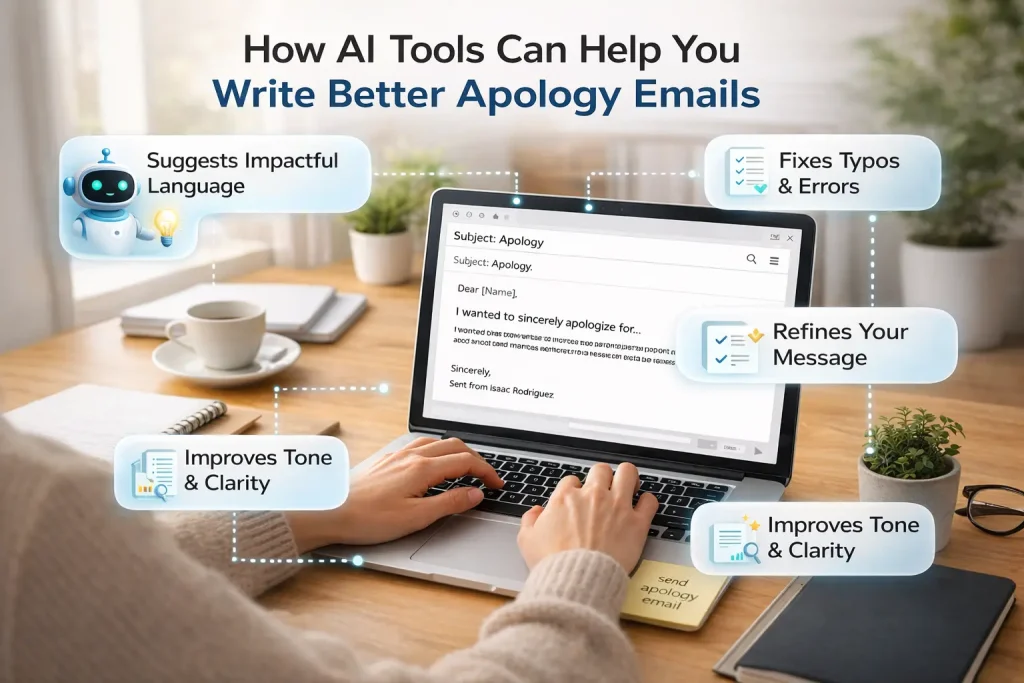
How AI Tools Can Help You Write Better Apology Emails
When you’re stressed about a mistake, writing clearly is harder than usual. You know what you want to say, but the words come out defensive, vague, or robotic. AI writing tools can help you get past the emotional fog and write something that actually sounds like accountability.
AI Writing Assistants as Emotional Intelligence Partners
In my view, AI writing tools have evolved well beyond simple grammar checking. They can now help you identify emotional triggers and improve the clarity of your apologies in ways you might miss on your own.
Benefits of AI assistance for apology emails:
- Detection of unintentionally defensive language that could undermine your apology
- Identification of passive voice constructions that might make your acceptance of responsibility seem weak
- Suggestions for more empathetic phrasing when your original wording might come across as cold
- Analysis of your overall tone to ensure it matches the severity of the situation
WriteMail.ai can flag phrasing you’d miss on your own – passive voice that dilutes your ownership, conditional language that sounds like a non-apology, or a tone that’s too formal for the relationship. The tool catches what your stressed brain won’t.
Maintaining Authenticity While Using AI
A common worry: will AI make the apology feel fake? Only if you send the first draft as-is. The point is to use AI for structure and tone-checking, then rewrite in your own voice.
To keep it authentic:
- Using AI to create a structural framework for your apology, then infusing it with personal details
- Reviewing AI suggestions as options rather than mandates—trust your knowledge of the relationship
- Reading the final version aloud to ensure it sounds like you and feels natural
- Having a trusted colleague review both the AI-generated version and your edited version to provide feedback
Example: AI-Enhanced Apology Refinement
My sincere apology for the presentation error
AI assistance helped transform this email from an earlier draft that included phrases like “there was an error in the presentation” (passive voice) and “I apologize if this caused any issues” (conditional apology) to the more direct, responsibility-taking version above.
Tools for Following Through on Commitments
The technology that helps you craft a better apology can also ensure you follow through on the commitments you make within it. When you promise specific actions in your apology email, your credibility depends on delivering them.
Technology for commitment fulfillment:
- Use calendar integration to schedule immediate reminders for promised actions
- Set up automated follow-up emails to check in with the affected party
- Create project management tasks for longer-term commitments mentioned in your apology
- Implement notification systems that alert you before similar mistakes might recur
Companies that systematically track their post-apology commitments – with calendar reminders, task management, and scheduled check-ins – tend to retain more customers after service failures, in my experience.
Balancing Technology and Human Touch
Technology helps, but it’s not a substitute for judgment. The danger isn’t using AI – it’s outsourcing your thinking to it entirely.
To maintain the personal touch while using technology:
- Include specific details that show you understand exactly what went wrong
- Reference previous positive interactions to remind the recipient of your established relationship
- Consider following up with a phone call after sending important apology emails
- Use video messaging for serious apologies when in-person meetings aren’t possible
When you’re genuinely sorry, AI helps you say it clearly. When you’re not sure how to phrase it, AI gives you a starting point. Either way, the apology still has to come from you – the tool just makes sure it lands the way you intended.
Taking Responsibility: The Path to Rebuilt Trust
A good apology email has four parts: acknowledge what happened, show you understand the impact, explain how you’ll prevent it next time, and follow through. What you leave out matters just as much – skip the non-apologies, the over-explanations, and the promises you can’t keep.
Before you write, think about who’s reading it. A client needs formality and a concrete remedy. A colleague needs directness and a plan. Your boss needs ownership and a prevention strategy. The audience shapes the tone – the accountability stays the same.
Before you hit send, read the email as if you received it. Would you believe this person? Would you feel heard? If the answer isn’t a clear yes, revise.
When writing the apology feels overwhelming, WriteMail.ai can help you get the first draft right – so you can focus on making it personal instead of staring at a blank screen.
The mistake already happened. What you do next is the part you still control.