




You wrote “Just checking in” this week. Maybe twice. So did your manager, and so did the person who is about to ignore it.
Stock phrases are handy. They save you a few seconds of thinking. They also make you sound like a template, and a few of them sound like a complaint wearing a tie.
Here are the phrases that wear out first, why readers wince at them, and what to write instead.
Why readers wince
When you see the same phrase for the hundredth time, you stop reading the words and start reading the tone. And the tone is often “I’m annoyed, but I’m being polite about it.”
In an August 2026, ZeroBounce survey of 2,000 professionals in the U.S. and Europe, 52% said “Just to be clear” comes across as passive-aggressive, and “Per my last email” was close behind at 40%. The survey page says phrases like these “sound like corrections.” It comes from an email vendor, so treat it as a useful signal, not a verdict.
Here is the twist. “Per my last email” gets the villain reputation, yet in that survey “Just to be clear” beat it.
An older survey found plenty of the same irritations. A 2020 Perkbox survey of 1,928 people ranked “Just looping in…” (37%) and “As per my last email” (33%) as the most annoying email clichés. The page also notes that three of its top five were about following up on an earlier email.
Now the awkward part. You probably use some of these yourself. In the ZeroBounce results, 37% of people said “Thanks in advance” is one of the phrases they use most. And 30% found “Any updates on this?” passive-aggressive while 30% said they use it often. Plenty of us roll our eyes at a phrase and then type it anyway.
The phrase swap table
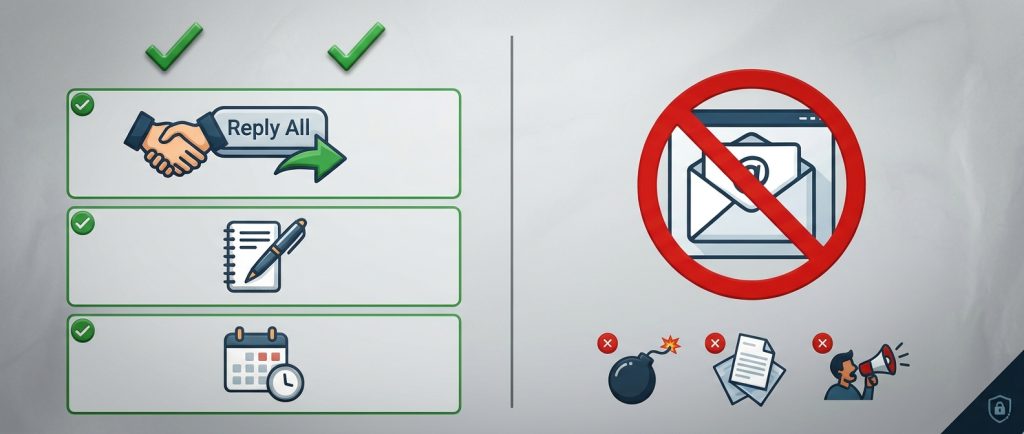
The pattern behind every fix is the same. Say the actual thing, name the ask, and add a date.
| Overused Phrase | Why It Lands Badly | Say This Instead |
| Just to be clear | Sounds like a correction | “To confirm, I understood it this way. Is that right?” |
| Per my last email | Points at their mistake | “The details are in my Monday email. Short version: the file is due Friday.” |
| As previously discussed | Implies they forgot | “Here is where we landed: launch is Monday.” |
| Just checking in | Asks for nothing | “Can you send the draft by Thursday?” |
| Any updates on this? | Vague and a bit tense | “Are you on track for Friday? If not, what’s blocking you?” |
| Just looping in | Drops context on a stranger | “Adding Sam, who owns billing. Sam, can you confirm by noon?” |
| Friendly reminder | Not very friendly | “The form is due Friday. Here is the link.” |
| Please advise | Hands off the thinking | “Which option do you prefer, A or B?” |
| Thanks in advance | Assumes the answer is yes | “Could you send it by 3 pm? Thank you.” |
| Going forward | Corporate filler | “From now on,” or “In the future,” |
| Hope this email finds you well | Empty opener | Skip it, or open with the point |
| Circling back | Jargon for “I’m chasing you” | “Back to the budget question: do you have a decision?” |
That “going forward” swap is not just a style opinion. The UK government’s A to Z style guide says “Plain English is mandatory for all of GOV.UK” and tells writers to replace “going forward” and “moving forward” with “from now on” or “in the future.” It also calls “in order to” “usually not needed.” The guide is about web pages, not email, but the idea carries over fine. Short, plain words get read.
Four swaps in real situations
Phrases are easier to fix when you can see them in a sentence. Here are four common office moments.
Chasing a late reply
Instead of:
Try:
The second version gives Dana a task and a deadline. She can say yes, no, or “Friday,” and all three are useful.
Correcting a misunderstanding
Instead of:
Try:
You still make the correction. You just skip the part where you sound like you are reading someone their rights.
Looping someone in
Instead of:
Try:
“Just looping in” tells Marcus nothing. The better version tells him why he is there and what you need.
Sending a vague update
Instead of:
Try:
Three short sentences beat one foggy one. If you cannot write the specifics, you may need to check on the work before you send the update.
The quiet offenders
Some phrases do not annoy anyone in particular. They just take up room. “Reaching out,” “touch base,” and “let me know if you have any questions” all fall in this group.
Try “I’m writing about the invoice” in place of “I’m reaching out regarding the invoice.” Try “Can we talk Tuesday?” in place of “Let’s touch base.” And if you end an email with “let me know if you have any questions,” ask yourself if the reader needed to be told. People know they can reply. That is how email works.
A quick check before you hit send
You do not need to ban every phrase. “Thank you” is fine. “Hi” is fine. A friendly opener is fine when you mean it. The trouble starts when a phrase is doing the job of a sentence you did not want to write.
Before you send, run three checks:
- Read the first line. If it could open any email to anyone, rewrite it.
- Find the ask. If the reader has to hunt for what you want, move it up.
- Add a date. “Soon” and “when you can” are not dates.
If you would rather not start from a blank reply, a tool like WriteMail.ai can draft one from a few notes. Just read the draft the same way, and cut any stock phrase that slips in.
Conclusion: Say the Real Thing
Overused phrases are not a sin. They are a habit, and habits are easy to fix once you can see them. Cut the filler, say the real thing, name the ask, and put a date on it.
Your reader will thank you. Not in advance, either.