


Last year, I found myself in what should have been an enviable position—juggling multiple job offers after months of searching. But as I sat at my desk crafting an email to decline one of those opportunities, my fingers froze over the keyboard. How exactly do you say “thanks, but no thanks” without burning bridges?
If you’re facing this same dilemma, you’re not alone. In my experience, building an email tool used by thousands, most people feel genuinely anxious about declining a job offer. And that anxiety is justified – CareerPlug’s hiring research shows 52% of job seekers have declined an offer due to a poor experience, which means hiring managers are used to hearing “no” but remember how you said it.
Turning down a job offer is a delicate situation that requires tact, professionalism, and clear communication. Whether you’ve received a better offer elsewhere, recognized the position isn’t the right fit, or your circumstances have changed, how you decline matters tremendously for your professional reputation.
In this guide, I’ll walk you through exactly how to write a rejection email that maintains positive relationships and leaves doors open for future opportunities. You’ll learn the essential components every rejection email should include, see real-world templates you can adapt for your situation, and discover the common pitfalls that could accidentally burn professional bridges.
Through WriteMail.ai, I’ve seen how thousands of people handle decline emails – the ones that keep doors open and the ones that burn bridges. The key lies in how you craft your message—balancing honesty with diplomacy and gratitude with clarity.
Let’s dive into the step-by-step process of declining a job offer via email in a way that preserves and potentially even strengthens your professional relationships.
Essential Elements of a Professional Decline Email
When you’re turning down a job offer, how you structure your email matters just as much as what you say. A well-crafted decline email demonstrates your professionalism and helps preserve the relationship for future opportunities. Let me walk you through the key components you should include in your message.
Crafting a Clear Subject Line
Your subject line should immediately communicate the purpose of your email without being abrupt or vague. I recommend being direct but polite. A subject line like “Regarding Job Offer for [Position Title]” or “Response to Job Offer – [Your Name]” works well. This gives the recipient immediate context without revealing the decline until they open the email, which is more respectful than putting “Job Offer Decline” directly in the subject.
Opening with a Proper Greeting
Always begin with a personalized greeting. Address the hiring manager or recruiter by name, using the appropriate title. If you’ve built rapport during the interview process, you’ll know whether “Dear Mr./Ms. [Last Name]” or “Hello [First Name]” is more appropriate based on your previous interactions and the company culture.
Expressing Genuine Appreciation
The first paragraph of your email should express sincere gratitude. You want to acknowledge:
- The opportunity presented to you
- The time they invested in your candidacy
- The positive aspects of the company or role that you appreciated learning about
This appreciation sets a positive tone before you deliver the news that you’re declining the offer.
Stating Your Decision Clearly
After expressing thanks, you need to clearly state your decision to decline. Don’t bury this information or be ambiguous. I’ve seen too many candidates dance around the actual decline, which only creates confusion and frustration. Be direct but tactful with statements like: “After careful consideration, I have decided to decline the offer for the [Position] role.”
Providing a Brief Explanation
While you don’t need to share every detail of your decision-making process, offering a concise, honest reason shows respect for the employer’s time and investment in you. The key here is being truthful without oversharing or being negative about the company.
Closing on a Positive Note
End your email by reiterating your appreciation and expressing interest in maintaining a professional connection. This might include:
- Thanking them again for the opportunity
- Expressing hope for possible future collaboration
- Wishing them success in finding the right candidate
A professional sign-off like “Sincerely” or “Best regards” followed by your full name and contact information completes the email.
Example of a Complete Decline Email Response to Marketing Manager Position Offer – Jamie Smith
The Importance of Formatting and Length
When you’re formatting your decline email, keep these considerations in mind:
- Length: Keep your email concise—ideally three to four short paragraphs. Hiring managers are busy and appreciate directness.
- Spacing: Use paragraph breaks to make your email scannable and easy to read.
- Tone: Maintain a warm but professional tone throughout the message.
- Proofreading: Carefully review for any typos or errors—this final communication still reflects on your professionalism.
Remember that this email may be your last impression with this employer, but the professional world is smaller than you might think. I’ve seen numerous cases where candidates who declined offers professionally were later contacted for even better opportunities at the same company. By including all these essential elements in your decline email, you’re not just turning down a job—you’re maintaining a valuable professional connection for your future.
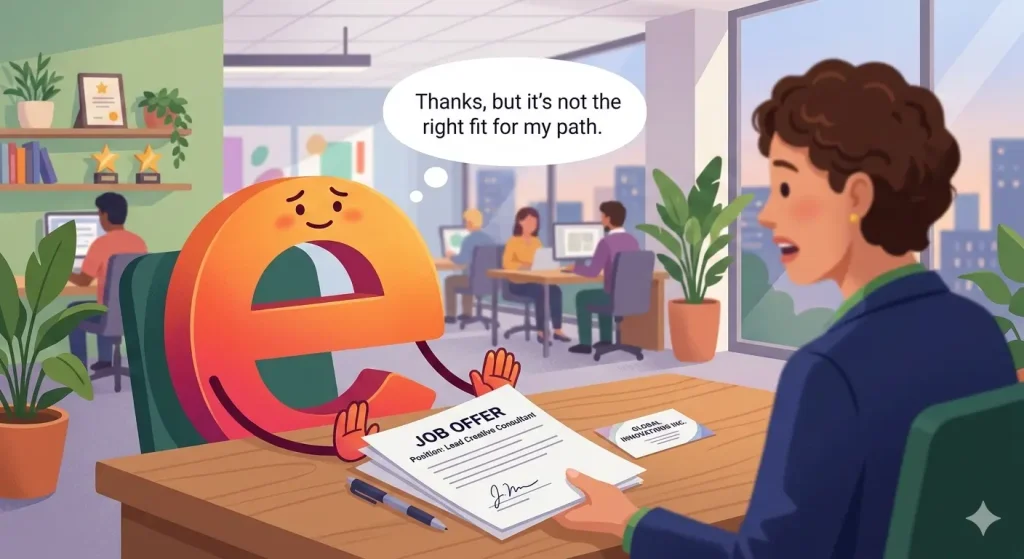
Crafting the Perfect Reason for Declining
When you’re turning down a job offer, one of the most delicate parts is explaining why. I’ve found that striking the right balance between honesty and diplomacy is crucial—you want to be truthful without burning bridges or oversharing personal details.
Most hiring managers would rather hear your honest reason than get a vague “I’ve decided to go in a different direction.” This transparency helps them improve their hiring process and better understand candidate expectations. When you provide a thoughtful explanation, you’re not only showing respect but also helping the company grow.
Finding the Balance Between Honesty and Tact
I recommend following these principles when explaining your decision:
- Be truthful but tactful: Frame your reason in a way that’s honest without being unnecessarily negative or critical.
- Keep it concise: Your explanation doesn’t need to be lengthy—a few sentences that get to the heart of your decision are sufficient.
- Focus on your career path: Whenever possible, frame your reason in terms of your professional goals rather than company shortcomings.
- Express appreciation: Balance your reason with genuine gratitude for the opportunity.
Example: Declining Due to Compensation Regarding Your Job Offer – Marketing Manager Position
Notice how this example acknowledges the specific positive aspects of the company while clearly but diplomatically stating the reason for declining. I’ve kept the explanation focused on the candidate’s career path rather than criticizing the company’s compensation structure.
Common Reasons and How to Express Them Professionally
Here are some typical scenarios you might face and how I suggest handling them:
- Accepting another offer: “I’ve accepted another position that more closely aligns with my immediate career objectives in [specific field].”
- Compensation concerns: “After reviewing the complete compensation package, I’ve determined it doesn’t quite meet my financial requirements at this stage of my career.”
- Role misalignment: “Upon further reflection, I believe my skills and experience would be better utilized in a role with more emphasis on [specific skill/area].”
- Company culture: “I’m seeking an environment that offers more [specific quality: flexibility, collaborative opportunities, etc.] in my day-to-day work.”
- Location/commute: “My personal circumstances have changed, making the location/commute challenging for me at this time.”
Avoiding Negativity While Maintaining Honesty
When crafting your reason, I strongly recommend avoiding these common pitfalls:
- Criticism of the team or interviewer: Even if you had concerns about potential colleagues, keep these observations to yourself.
- Disparaging company practices: If you noticed red flags in how the company operates, find a more positive way to frame your decision.
- Overly detailed personal issues: While personal circumstances are valid reasons, you don’t need to share intimate details.
- Mentioning significantly higher compensation elsewhere: Simply stating another offer better meets your financial needs is sufficient without specifying amounts that might create awkwardness.
Remember, the industry is often smaller than you think, professionals frequently cross paths throughout their careers. The hiring manager you’re declining today might be someone you’ll want to work with in the future.
Setting Appropriate Boundaries
While honesty is important, you should maintain professional boundaries in your explanation. You don’t owe the employer highly personal details or information that might compromise your position with other companies.
If you’re pressed for more details during a follow-up call, you can politely maintain your boundaries with phrases like:
- “I’ve carefully considered all aspects of both opportunities and made the decision that best supports my career goals at this time.”
- “While I’d prefer not to discuss specific details of my other offer, I can share that it aligned better with my [priorities/goals/needs].”
- “I appreciate your interest in my decision-making process, but I’m comfortable with the explanation I’ve provided and would prefer to leave it at that.”
Finding the right words to decline an offer while preserving relationships can be challenging. The key is to be respectful, prompt, and authentic while maintaining appropriate professional boundaries. When you master this delicate communication skill, you’ll not only preserve your professional reputation but potentially leave the door open for future opportunities.

Timing and Follow-up Considerations
When declining a job offer, timing isn’t just a courtesy—it’s a critical element of professional communication that can significantly impact your reputation. I’ve found that handling this aspect thoughtfully can make all the difference in how employers remember you long after the interaction ends.
Respond Promptly to Maintain Professionalism
I always recommend responding to a job offer within 24-48 hours, even if it’s just to acknowledge receipt while you’re still deciding. Why? Because companies are often juggling multiple candidates, and your prompt communication helps them move forward with their hiring process.
When you delay declining an offer, you’re potentially preventing the employer from extending an offer to their second-choice candidate. In fact, recruitment professionals report that a delayed decline can extend their hiring process by up to two weeks—something that can create a negative impression of you that lasts far beyond this single interaction.
Best practices for timely responses:
- Acknowledge receipt of the offer immediately, even if you need time to decide
- Set clear expectations if you need more time (“I appreciate this offer and would like to carefully consider it. Would it be possible to provide my final decision by Thursday?”)
- Never let more than 48 hours pass without some form of communication
- If your decision timeline changes, proactively communicate this to the hiring manager
The Delicate Situation: Declining After Accepting
Sometimes circumstances change, and you might find yourself in the uncomfortable position of needing to decline an offer you’ve already accepted. This situation requires especially careful handling. According to a Robert Half survey, 28% of professionals have backed out after initially accepting a job offer – and 44% of those said it was because a better offer came along.
If you find yourself in this position, you should prioritize a phone call over an email when possible. However, following up with a formal email to document the conversation is always appropriate.
Strategic Timing for Better Reception
Interestingly, research suggests that the day and time you send your decline email can affect how it’s received. When you’re delivering disappointing news, timing matters more than you might think.
Based on studies of email response patterns, I’ve found that Tuesday through Thursday mornings (between 9-11 AM) typically yield the most professional and measured responses from hiring managers. Why? They’re not overwhelmed by Monday’s backlog or Friday’s rush to finish projects, and morning emails tend to be processed when people are fresher and more level-headed.
Avoid sending decline emails during these times if possible:
- Late Friday afternoons (can seem like you’re trying to avoid discussion)
- Very early mornings or late evenings (appears unprofessional)
- Immediately before holidays or known company events
- Monday mornings when inboxes are typically fullest
Setting Clear Expectations for Next Steps
When you decline a position, there are often loose ends to tie up. Being proactive about addressing these demonstrates your professionalism and attention to detail.
I recommend explicitly mentioning any follow-up actions in your email:
- Whether you’ll return any company materials you’ve received
- If there’s paperwork you need to complete to formally close the process
- Your availability for any wrap-up conversations if needed
- How you’d like to stay connected professionally (LinkedIn, industry events, etc.)
Handling Potential Counteroffers
Be prepared for the possibility that your decline might trigger a counteroffer—especially if your reason for declining relates to compensation or role scope. Before sending your decline email, I suggest thinking through how you’d respond to potential negotiation attempts.
If you’re absolutely certain no counteroffer would change your mind, you can tactfully indicate this in your decline email with language like: “While I’ve given this careful consideration and my decision is final, I wanted to express my sincere appreciation for the opportunity.”
However, if you’re open to negotiation, you might use more open language: “While the current offer doesn’t quite meet my needs regarding [specific factor], I remain very interested in the position and would be open to discussing potential adjustments if possible.”
Remember that how you handle the timing and follow-up of your decline email sets the tone for your professional reputation. A thoughtful, prompt, and clear approach demonstrates the same qualities employers value in their team members—exactly the impression you want to leave, even as you turn down an opportunity.
Industry-Specific Considerations for Declining Offers
As HBR’s guide to turning down offers puts it: the goal isn’t just to say no – it’s to leave the recruiter thinking they’d still hire you for the right role. When you decline a job offer, it’s important to recognize that different industries have different expectations for communication style and etiquette. I’ve found that tailoring your approach based on the specific industry and company culture can make a significant difference in how your message is received.
Adapting Your Approach Across Different Sectors
The way you communicate a job offer decline should reflect the environment you’re corresponding with. Having worked with professionals across various sectors, I can tell you that what works in one industry might come across as inappropriate in another.
Corporate vs. Startup Environments:
- Corporate settings typically expect more formal language, structured communication, and adherence to traditional business etiquette.
- Startup environments often appreciate more conversational tones, authenticity, and concise messaging without excessive formality.
- Creative industries may be more receptive to personality in your communication, while still maintaining professionalism.
- Technical fields often value directness and clarity above all, with less emphasis on elaborate explanations.
When you’re crafting your decline email, consider the company’s communication style throughout your interview process. Did they use formal language or a more casual approach? You’ll want to mirror this tone while maintaining professionalism.
Example: Contrasting Approaches for Different Industries Regarding the Financial Analyst Position at Morgan Stanley
Startup Environment Approach Tech Developer Role at LaunchPad – My Decision
Regulated Industries and Government Positions
If you’re declining an offer in a regulated industry like healthcare, finance, or government, you should be aware that these sectors often have stricter protocols around communication. When I work with clients in these fields, I recommend:
- Maintaining heightened formality throughout the message
- Being especially precise about timing and documentation
- Acknowledging any confidentiality requirements
- Following specific protocols mentioned during the hiring process
For government positions in particular, you might need to complete additional paperwork when declining an offer. Make sure to ask about any required forms or procedures in your decline email.
International and Cross-Cultural Considerations
When you’re declining an offer from an international company, cultural nuances can significantly impact how your message is perceived. I’ve noticed that being aware of these differences can help you maintain positive relationships globally:
Cultural Considerations for International Declines:
- In East Asian business cultures, indirect communication is often preferred—your reason for declining might need to be more subtle and face-saving for all parties
- In Northern European contexts, directness is typically appreciated—being clear and concise without excessive explanation often works well
- For Middle Eastern businesses, personal relationships are highly valued—emphasizing your appreciation for the connection formed during the interview process is important
- In Latin American professional settings, warm, personable communication is expected—a purely transactional decline might seem cold
When declining an international offer, research the specific cultural norms if you’re unfamiliar with them. I’ve found that even small adjustments in phrasing can make a significant difference in how your message is received.
Matching Your Tone to Company Culture
Beyond industry norms, individual company cultures significantly influence communication expectations. During your interview process, you likely gained insights into the organization’s values and communication style. Use these observations to inform your decline email:
- For traditional organizations with formal cultures, maintain appropriate distance and formality
- With people-first companies that emphasized relationships during interviews, acknowledge the personal connections you formed
- For innovation-focused organizations that prize creativity, a slightly more original approach might be appreciated
- With mission-driven organizations, acknowledging their purpose can show respect for their values
Remember that even within the same industry, company cultures can vary dramatically. A tech giant like IBM might expect different communication compared to a tech startup that’s been operating for just two years. When you tailor your message to both industry standards and specific company culture, you demonstrate attention to detail and interpersonal awareness—qualities valued across all professional settings.
By adapting your approach to the specific industry and organizational context, you can ensure your decline email maintains professional bridges rather than burning them. This industry-specific awareness demonstrates your professional maturity and leaves the door open for future opportunities, even as you’re saying “no” to the current one.
Common Mistakes to Avoid When Declining Job Offers
When you’re turning down a job offer, how you communicate your decision matters just as much as the decision itself. I’ve seen too many professionals damage their reputations by handling this delicate situation poorly. Let’s explore the common pitfalls you should avoid to ensure you maintain professional relationships even when saying “no thanks.”
The Silent Treatment: Why Ghosting Is Career Suicide
You might be tempted to avoid the awkward conversation altogether, but ghosting an employer is perhaps the worst approach you can take. Nearly every employer views ghosting negatively – and they remember it when your name comes up again. When you simply disappear without responding to an offer, you’re not just declining a job—you’re burning a professional bridge in spectacular fashion.
Remember that the hiring manager invested time and resources in your candidacy. When you ghost them, you’re essentially telling them their time wasn’t worth even a brief email. Instead, I recommend sending a prompt, respectful decline that acknowledges their investment in you, even if the conversation feels uncomfortable.
While honesty is important, there’s such a thing as too much information. When declining a job offer, you don’t need to provide exhaustive explanations about why the position isn’t right for you. Over-explaining often comes across as defensive or, worse, opens the door to counterarguments that might make the situation more uncomfortable.
Keep your explanation concise and focused on positive aspects rather than negative ones. For example, instead of detailing five things wrong with the offer, simply state that you’ve accepted another opportunity that better aligns with your career goals.
Poor vs. Improved Decline Email Example: RE: Job Offer – Marketing Coordinator Position
Now, let me show you how to transform that problematic email into something professional:
RE: Marketing Coordinator Position – Offer Decision
The Bridge Burner: Criticizing the Company or Process
Even if your experience wasn’t entirely positive, criticizing the company, position, or interview process in your decline email is never a good idea. The professional world is surprisingly small, and negative comments have a way of circulating beyond your intended audience.
When you’re writing your decline email, I suggest focusing exclusively on your decision rather than providing feedback about the company unless specifically requested. If you truly had a negative experience that warrants feedback, consider whether that feedback would be constructive and, if so, deliver it diplomatically in a separate communication after your decline has been acknowledged.
Remember that the person reading your email might one day be:
- A potential client at another company
- Your future colleague when you both move to different organizations
- A valuable network connection who could refer you to other opportunities
The Procrastinator: Waiting Too Long to Respond
When you’ve decided to decline an offer, sitting on that decision only complicates matters. The longer you wait, the more difficult the conversation becomes, and the more likely the employer is to feel that you’ve wasted their time.
I’ve found that hiring managers are far more understanding of a prompt decline than a delayed one. If you know you’re going to decline, do so within 24-48 hours of making your decision. This allows the company to move quickly to their next candidate and shows respect for their hiring timeline.
Pro tip: If you need more time to decide, it’s better to communicate that clearly with a specific timeframe rather than going silent. For example, “I appreciate this offer and would like to request until Friday to provide my final decision” is perfectly acceptable.
The Channel Switcher: Using Inappropriate Communication Methods
In our casual, text-centric world, you might be tempted to decline a job offer via text message, social media, or even a quick phone call. Resist this urge! A job offer is a formal business transaction that deserves a formal business response.
Always decline a job offer in writing via email (or a formal letter if that’s how the offer was extended). This approach provides:
- A clear record of your communication
- Time for you to carefully craft your message
- Professionalism that reflects well on your business etiquette
- Documentation for both parties of when and how the offer was declined
If you’ve built a strong rapport with the hiring manager and want to deliver the news personally, you can make a phone call, but always follow up with a formal email to document your decision.
The Vague Responder: Failing to Be Clear About Your Decision
Sometimes in an attempt to be polite, you might use language that’s too soft or ambiguous. This can create confusion about whether you’re actually declining or just negotiating. When declining an offer, you need to be crystal clear.
Rather than writing “I don’t think this opportunity is quite right for me at this time,” directly state “I am declining this offer” or “I must respectfully decline this position.” This clarity is professional and prevents any misunderstandings that could lead to awkward follow-up conversations.
By avoiding these common mistakes, you’ll ensure that your professional reputation remains intact even as you turn down opportunities. Remember, how you decline a job offer today may impact opportunities that come your way tomorrow. A respectful, prompt, and clear decline email shows that you’re a professional worth keeping in contact with, even if the current opportunity wasn’t the right fit.
Templates and AI Tools for Crafting Perfect Decline Emails
When you’re faced with the challenge of declining a job offer, having the right tools at your disposal can make all the difference. I’ve found that using templates and AI writing assistants can help you communicate your decision professionally while saving precious time during what’s often a busy period in your career.
Customizable Templates for Different Decline Scenarios
Having a collection of well-crafted templates can give you a solid starting point for your decline email. The key is finding templates that match your specific situation and then personalizing them appropriately.
Different decline scenarios you might encounter:
- Better offer elsewhere – When you’ve received a more attractive opportunity that better aligns with your career goals
- Salary/compensation issues – When the offered package doesn’t meet your financial needs or market value
- Personal circumstances – When family situations, health concerns, or location constraints make accepting impossible
- Company culture mismatch – When you realize the workplace environment isn’t the right fit for your working style
- Role responsibilities – When the actual position differs from what was discussed during interviews
How to Personalize Templates to Maintain Authenticity
A template should serve as a framework, not a finished product. When you use a template without personalizing it, hiring managers can typically spot this immediately, which can come across as impersonal or lazy.
Tips for authentic personalization:
- Reference specific conversations or interview moments
- Mention something unique about the company that impressed you
- Acknowledge particular team members who made your interview experience positive
- Customize the language to reflect your natural communication style
- Adapt the level of formality to match the company’s culture
Example: Personalizing a Decline Template Regarding the Marketing Manager Position – Job Offer Decision
Notice how this example incorporates specific details from the interview experience, mentions team members by name, and references particular aspects of the role and company that stood out. These personal touches transform a generic template into an authentic communication.
Using AI Assistance for Professional Decline Emails
AI writing tools have revolutionized how we approach challenging professional communications like job offer declines. When you’re struggling to find the right words or tone, WriteMail.ai can generate and refine professional decline emails that strike the perfect balance between honesty and tact.
Benefits of AI assistance for decline emails:
- Helps you find diplomatic language for uncomfortable situations
- Suggests professional phrasing alternatives when emotions might cloud your judgment
- Ensures your message maintains a positive, professional tone
- Saves time when you need to respond quickly to an offer
- Reduces anxiety around crafting these sensitive communications
Research from LinkedIn shows that 76% of hiring managers say they’re more likely to consider candidates for future positions if they decline offers professionally and thoughtfully. When you use AI tools to help craft these messages, you’re investing in your professional network’s long-term health.
Finding the Right Tone and Language for Difficult Messages
Declining a job offer requires a delicate balance of honesty, gratitude, and professionalism. I’ve found that many professionals struggle with striking this balance on their own.
AI writing assistants excel at suggesting language that maintains professionalism even when delivering disappointing news. You can specify parameters like formality level, directness, and detail to generate a message that feels appropriate for your specific situation and relationship with the employer.
Multilingual Capabilities for International Correspondence
If you’re corresponding with international companies, nuances in tone and etiquette become even more important. What’s considered appropriately direct in one culture might seem abrupt or even rude in another.
When you need to decline offers from companies based in different countries, AI tools with multilingual capabilities can help you navigate these cultural differences. For example, declining a job offer in Japan might require more extensive expressions of gratitude and indirect language compared to a more straightforward approach expected in German business culture.
Cultural considerations for international declines:
- Appropriate levels of directness vs. indirectness
- Expected formality in business communications
- Cultural expectations around providing reasons for declining
- Proper salutations and closings for business correspondence
- Timing expectations for response in different cultures
Remember that declining a job offer isn’t the end of your professional relationship—it’s simply a transition to a different kind of relationship. By using the right templates, personalizing effectively, and leveraging AI tools when appropriate, you can ensure this transition preserves and potentially even strengthens your professional network for years to come.
Conclusion: Maintaining Professionalism Opens Future Doors
Declining a job offer might feel uncomfortable, but as we’ve explored throughout this article, handling this situation professionally can actually strengthen your professional network rather than damage it. Remember, your response isn’t just about this single opportunity—it’s an investment in your long-term career reputation.
When you craft your decline email, I strongly recommend that you focus on these key elements: timeliness, gratitude, honesty (without oversharing), and ending on a positive note. These fundamentals will serve you well across any industry or situation.
You should consider that each declined offer is potentially a future opportunity in disguise. By maintaining professionalism, you keep doors open that might lead to better-aligned positions down the road. In fact, I’ve seen professionals receive improved offers months later from companies they initially turned down—all because they handled the decline with grace and respect.
If you’re struggling with finding the right words or tone, WriteMail.ai can help you generate professional decline emails that hit all the right notes while saving you the stress of multiple rewrites. The tool is particularly helpful when you need to decline offers across different industries or cultural contexts.
When you write your next decline email, I encourage you to:
- Respond promptly—within 24-48 hours whenever possible
- Express genuine appreciation for the opportunity
- Provide a concise, honest reason without unnecessary details
- Leave the door open for future interactions
Remember that how you decline speaks volumes about who you are as a professional. In today’s interconnected business world, the hiring manager you’re emailing today might be leading your dream company tomorrow.
I believe that mastering professional communication in challenging situations like job offer declinations sets you apart in your career journey. By implementing these techniques, you’re not just writing better emails—you’re building a reputation for integrity and professionalism that will serve you throughout your career.